Introduction
"I bet on a night race the same way I bet on a daytime race, and none of my picks hit..."
Sound familiar?
Night races have completely different characteristics from daytime races. Temperature, water conditions, lighting, and racer condition all shift in ways that affect your predictions.
This article breaks down the 5 defining features of night races and a data-driven strategy for betting on them.
What are night races?
Night races typically run from around 3:00 PM to 8:30 PM. Because they're easy to catch after work, they've grown rapidly in popularity in recent years.
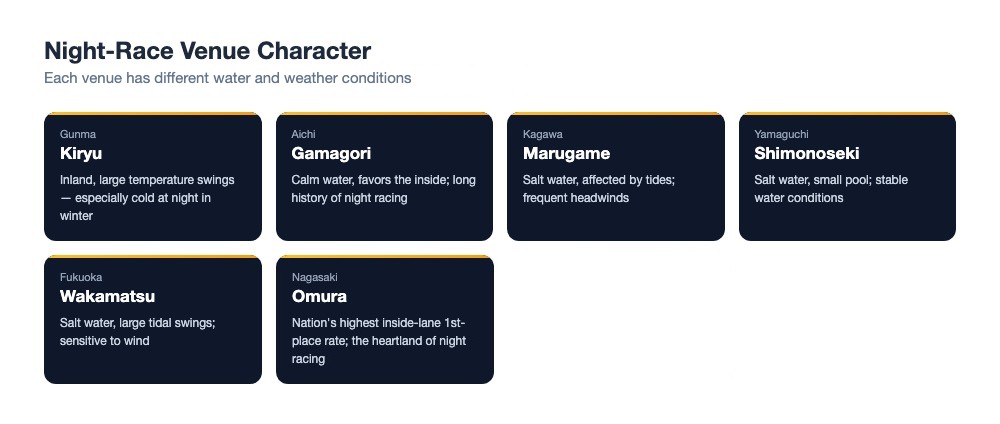
The 7 night-race venues
| Venue | Character |
|---|---|
| Kiryu (Gunma) | Inland, large temperature swings — especially cold at night in winter |
| Gamagori (Aichi) | Calm water, favors the inside; long history of night racing |
| Suminoe (Osaka) | Pool-type water surrounded by concrete seawalls; night racing year-round except some races |
| Marugame (Kagawa) | Salt water, affected by tides; frequent headwinds |
| Shimonoseki (Yamaguchi) | Salt water, small pool; stable water conditions |
| Wakamatsu (Fukuoka) | Salt water, large tidal swings; sensitive to wind |
| Omura (Nagasaki) | Nation's highest inside-lane 1st-place rate; the heartland of night racing |
5 differences from daytime racing
1. Falling temperature changes motor output
The single biggest feature of night racing is the drop in temperature.
The mechanism:
- As temperature falls, air density rises
- Higher air density means more oxygen reaches the motor
- The result: motor output increases
Impact on your predictions:
- Late-evening races tend to show a bigger gap in motor performance than early daytime races
- Racers skilled at tuning their motor gain an edge
- Be especially cautious on winter nights where the temperature drops 10°C or more
Tip: Since exhibition times are often measured during the day, actual race times at night tend to run faster than the exhibition time suggested.
2. Water conditions tend to be more stable
Wind tends to weaken at night compared to daytime.
Why:
- After sunset, the temperature gradient at ground level shrinks, weakening convection
- This is especially pronounced at inland Kiryu, and even at bay-adjacent venues like Gamagori and Omura
Impact on your predictions:
- Calmer water makes an inside wire-to-wire win more likely
- Start timing becomes easier to nail
- Upsets become less common
3. Racer condition changes
Since night races fall later in the day, racer fatigue starts to factor into predictions.
Things to check:
- A racer on their 2nd or 3rd race of the day may be carrying fatigue
- Conversely, a racer's first night race of the day tends to have sharper focus
- Veteran racers have more night-racing experience and adapt better
Important: Performance can differ noticeably between racers who race under lights regularly and those who don't. Check how often each racer competes at night.
4. Lighting affects visibility
At night races, light reflecting off the water changes visibility compared to daytime.
What it affects:
- The wake from other boats becomes harder to see
- Judging distance to the turn markers gets trickier
- Racers unfamiliar with this can swing wide on turns
How to use this in your predictions:
- Favor racers with plenty of experience racing at night venues
- Overtakes from the center or outside lanes are especially affected by lighting
- The net effect: the inside lane becomes even more favored
5. Inside win rate climbs as the night goes on
This is the single most important data point for night racing.
The trend:
- Early races (around 3 PM) show an inside 1st-place rate close to the norm
- The inside 1st-place rate climbs as the evening progresses
- Near the final races, some venues see an inside 1st-place rate above 60%
Why it compounds:
- Temperature falls → motor output rises → start power improves
- Wind weakens → water stabilizes → start precision improves
- Lighting effects → outside attacks become harder to pull off
| Time slot | Inside 1st-place rate (approx.) | Character |
|---|---|---|
| 3:00–5:00 PM | 50–55% | Close to daytime norms |
| 5:00–7:00 PM | 55–60% | Gradually shifting toward the inside |
| 7:00–8:30 PM | 60–65% | Prime time for inside wire-to-wire wins |
3 night-race-specific strategies
Strategy 1: Build later races around an inside wire-to-wire win
For races after 5 PM, betting around lane 1 winning wire-to-wire as your core pick is the standard rule of thumb, unless lane 1's racer is clearly weak.
Example bet structure:
- Fix lane 1 for 1st in Trifecta bets
- Cover lanes 2–3 for 2nd, and spread wide for 3rd
- Since results tend to be predictable, watch the balance against the odds
Strategy 2: Factor temperature swings into your motor evaluation
Judging a motor purely by its daytime exhibition time is risky.
What to check:
- How much the temperature is expected to drop that day (day vs. night)
- Racers with a high motor 2nd-place-or-better rate gain even more of an edge at night
- Class A1 racers skilled at tuning tend to get the most out of their motor at night
Strategy 3: Learn each night venue's individual character
Not all night-race venues are the same. Understanding each venue's traits matters.
| Venue | Inside advantage | Volatility | Strategy tips |
|---|---|---|---|
| Kiryu | ★★★☆☆ | ★★★★☆ | Watch winter temperature swings; upsets likely on days with the "Akagi-oroshi" wind |
| Gamagori | ★★★★☆ | ★★☆☆☆ | Calm water favors the inside; lean on solid bets |
| Marugame | ★★★☆☆ | ★★★☆☆ | Check the tide; the inside is favored at high tide |
| Shimonoseki | ★★★★☆ | ★★☆☆☆ | Small, stable pool; high inside wire-to-wire rate |
| Wakamatsu | ★★★☆☆ | ★★★☆☆ | Water conditions shift with wind and tide — rely on the data |
| Omura | ★★★★★ | ★☆☆☆☆ | The inside-lane heartland of night racing; results tend to be predictable |
Streamline your night-race predictions with Ryujin Radar
Night races are a genre where understanding the fundamentals can meaningfully raise your hit rate. But researching the water conditions, temperature swings, and each racer's night-racing aptitude across every night-race venue yourself is a lot of work.
With Ryujin Radar:
- All night races across every venue are analyzed by AI in real time
- Motor performance, racer data, and water conditions are judged holistically
- First-Mark Turn Predictions visualize each lane's attacking and defensive positioning
- The Upset Index lets you gauge a race's stability or upset potential in advance
Don't rely on "the inside is favored" alone — start making precise, data-driven predictions for night races.
👉 See Ryujin Radar's night race predictions
Completely free, with AI predictions published for every night race.
Summary
5 keys to night-race strategy:
- Falling temperature changes motor output — don't take the exhibition time at face value
- Water stabilizes and favors the inside — especially once the wind weakens at night
- Watch racer fatigue and night-racing experience — familiarity makes a real difference
- Lighting makes outside attacks harder — a tailwind for the inside lane
- Inside win rate climbs as the night goes on — pay special attention after 5 PM
Predicting night races the same way you predict daytime races won't win. Understand the data and characteristics unique to night racing, and aim for a higher hit rate!
Tags: #BoatRacing #NightRace #NightRaceStrategy #BoatRacingPredictions #NightRaceFeatures #AIPrediction #RyujinRadar