"Do AI predictions actually work?"
As more boat racing AI prediction services appear, many people are asking this question. Honestly, being skeptical is the right instinct.
In an industry rife with exaggerated claims like "90%+ hit rate!" or "¥1,000,000 profit every month!", taking numbers at face value is risky.
In this article, we share the results of Ryujin Radar's own honest audit of its prediction accuracy, based on 3 months and over 15,000 races of data — the good and the bad, all disclosed.
3 reasons to be skeptical of AI predictions
Distrust of AI predictions is well founded.
- Many services never publish their track record — they post screenshots only when they win, and quietly ignore the races they lose
- The word "AI" is used as a marketing buzzword — a service can call itself "AI-powered" even if it's really just a basic spreadsheet formula
- The verification period and sample size are often unclear — a single good week gets presented as "our track record"
To confront this problem head-on, Ryujin Radar publishes the results of every race it predicts, directly on the site. Every win and every loss is there for anyone to check.
Results from 3 months and 15,000 races
Overall hit rate
| Metric | Value |
|---|---|
| Races evaluated | ~15,000 races |
| Evaluation period | 3 months |
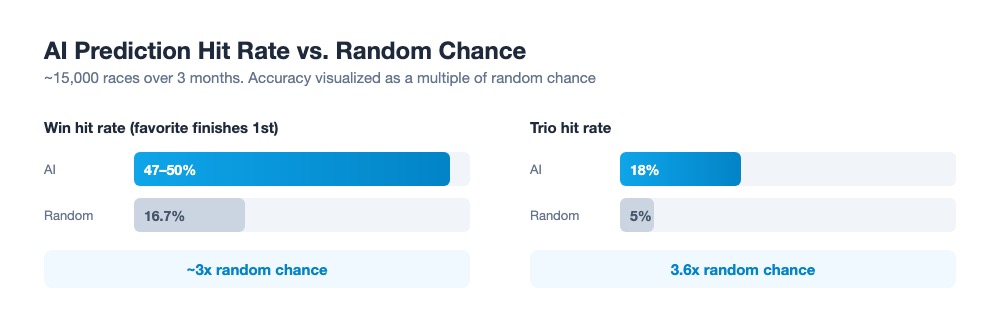
| Win hit rate (favorite finishes 1st) | ~47–50% |
| Place hit rate (favorite finishes top 2) | ~60–65% |
| Trio hit rate | ~18% |
Boat racing has 6 boats per race, so a random pick has roughly a 16.7% chance of winning. The AI's 47–50% is about 3 times better than random chance.
At the same time, the flip side shouldn't be ignored: the AI is wrong roughly half the time. It's not infallible.
What an 18% Trio hit rate means
A Trio bet requires correctly picking the 3 boats that finish in the top 3 (order doesn't matter), out of 20 possible combinations. A random pick has a 5% hit rate.
18% is 3.6 times better than random, but flip it around and it also means you'll be wrong more than 4 times out of 5. Winning consistently on Trio bets, race after race, is not easy.
How AI prediction works, and reading each race's volatility
Ryujin Radar analyzes every race with a single unified AI model. On top of that, each race's volatility is visualized through the "Upset Index," a percentile-based indicator that classifies races as "Upset alert (high)," "Standard," or "Favorite friendly."
| Item | Description |
|---|---|
| Prediction model | One unified model (analyzes all factors holistically) |
| Volatility indicator | Upset Index |
| Labels | Upset alert (high) / Standard / Favorite friendly |
The key point: AI prediction is no silver bullet. Use the Upset Index to adjust your approach to each race — betting conservatively on "Favorite friendly" races and keeping an eye on big payouts on "Upset alert (high)" ones.
The reality of return rate — does it actually pay off?
This is the part that deserves the most honesty.
Betting evenly on every race makes a 100% return rate hard to reach
Boat racing has a deduction rate of roughly 25% — meaning about a quarter of every yen wagered is taken out of the pool from the start.
If you bet a flat amount on every single race, Ryujin Radar's standard predictions return roughly 88–94%. The hit rate is 3x random, but that alone isn't enough to fully overcome the 25% deduction.
Curating races tends to improve the return rate
Instead of betting flat on every race, focusing only on the races where the AI's confidence is highest tends to improve the return rate, based on our evaluation (104% return rate, 30% Trio hit rate on curated races only).
In other words, instead of "letting the AI pick every race," betting only on the AI's curated picks can potentially break through the deduction-rate wall.
That said, these numbers aren't a guarantee of future performance either — results shift constantly with market conditions and odds movement. See the accuracy page for the latest track record.
How Ryujin Radar differs from other AI prediction services
When choosing an AI prediction service, the most important question is "can I actually verify the track record?"
| Comparison | Typical prediction sites | Ryujin Radar |
|---|---|---|
| Track record disclosure | Only wins are published | Every race's result is published |
| Verifiability | Can't be checked by a third party | Anyone can verify it on the site |
| Price | Often ¥thousands–¥tens of thousands / month | Completely free |
| Basis for predictions | "Picked by a pro," and that's it | Shows the actual data-analysis indicators |
Ryujin Radar's defining trait is transparency of track record. Rather than cherry-picking favorable numbers, every day — wins and losses alike — is recorded.
The limits of AI prediction, and how to use it correctly
What AI can't do
No matter how accurate it is, AI has real limits.
- It can't detect last-minute condition changes or trouble — a racer's condition on the day isn't fully reflected in the data
- Start timing isn't perfectly predictable — flying starts and late starts are inherently hard to forecast
- It can't fully predict odds movement — a large last-minute bet can shift expected value right before the window closes
- A 100% hit rate is impossible — no matter how good the AI is, some races will always be missed
How to use AI predictions correctly
- Treat it as one input among several — don't take the AI's pick at face value; check the race information yourself too
- Be selective about races — instead of betting on everything, focus on the races the AI is most confident about
- Manage your bankroll strictly — set a daily budget and don't chase a single big win
- Take a long-term view — judge performance over a month, not by a single day's win or loss
- Use the Upset Index as a guide — bet conservatively on "Favorite friendly" races, and watch for big payouts on "Upset alert (high)" ones
Summary — AI prediction isn't "magic," but it is a real weapon
Here's what 3 months and 15,000 races taught us:
- The AI's hit rate is about 3x random chance — it genuinely does "hit"
- But it's wrong about half the time — it's not infallible
- Betting flat on every race makes breaking 100% return rate difficult
- Curating races carefully can produce a net-positive return (104% when focused on the AI's highest-confidence picks)
- The single most important thing is transparency of track record — don't trust an AI prediction service you can't verify
AI prediction isn't "a magic tool that guarantees you'll win." But used correctly, it can be a real weapon that reliably improves your boat racing hit rate.
Ryujin Radar publishes its entire track record. See for yourself first.
Ryujin Radar — Try AI predictions for free
Tags: #AIPrediction #BoatRacing #HitRate #ReturnRate #AIAccuracyReview #RyujinRadar #DataAnalysis