"I bet on gut feeling every time, and I always lose..."
Many people don't feel confident predicting boat races. But prediction has a clear process and set of techniques. Betting on data instead of guesswork alone can dramatically change your hit rate.
In this article, Ryujin Radar shares the "how to actually predict a winner" process it has distilled from analyzing over 10,000 races. Whether you're a beginner or intermediate bettor, you'll walk away with a practical method you can use today.
The basic 5-step process
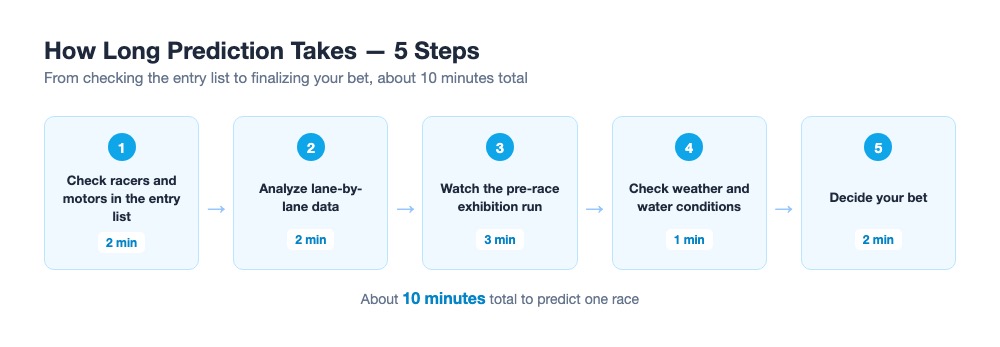
Predicting a boat race breaks down into 5 basic steps.
| Step | What to do | Time |
|---|---|---|
| ① | Check racers and motors in the entry list | 2 min |
| ② | Analyze lane-by-lane data | 2 min |
| ③ | Watch the pre-race exhibition run | 3 min |
| ④ | Check weather and water conditions | 1 min |
| ⑤ | Decide your bet | 2 min |
About 10 minutes total. Once you're used to it, 5 minutes is enough. Skipping this process and betting on a hunch is the number one reason bettors lose.
6 key factors in a good prediction
1. Racer win rate (the most important factor)
Win rate is the single most reliable measure of a racer's ability.
Rough benchmarks:
- 7.00+: Top-tier racer (SG class)
- 6.00–6.99: Strong Class A1 racer
- 5.00–5.99: Mid-tier
- 4.99 and below: Worth extra caution
✅ Tip: If a Class A1 racer (win rate 6.00+) is in lane 1, making them your core pick is the standard rule of thumb. Ryujin Radar's analysis shows that a Class A1 racer in lane 1 finishes 1st over 60% of the time.
That said, judging by overall win rate alone is risky. Also check the racer's venue-specific win rate, since water conditions vary significantly by venue — a racer with a strong national win rate can still struggle at a particular venue.
2. Motor 2nd-place-or-better rate
In boat racing, racers draw motors by lottery, and the difference in motor performance has a major effect on race outcomes.
| Motor 2nd-place-or-better rate | Rating | Impact on prediction |
|---|---|---|
| 45%+ | Elite motor | Can be trusted as your core pick |
| 40–44% | Strong motor | High reliability |
| 35–39% | Standard | Weigh alongside other factors |
| 30–34% | Slightly underperforming | Discount somewhat |
| Under 30% | Poor performance | Be cautious even with a strong racer |
✅ Tip: Judge by the combination of racer ability × motor performance. A Class A1 racer paired with a strong motor (40%+) is the most reliable pattern.
3. Lane-by-lane performance
Boat racing's defining feature is the overwhelming advantage of the inside lane. But how much of an advantage each lane has varies significantly by venue.
National average 1st-place rate by lane:
| Lane | 1st-place rate | Character |
|---|---|---|
| Lane 1 | ~55% | Overwhelmingly favored |
| Lane 2 | ~14% | Wins mainly by inside pass |
| Lane 3 | ~12% | Wins by overtake or overtake-and-pass |
| Lane 4 | ~11% | Occasional single big overtake |
| Lane 5 | ~6% | Depends heavily on how the race develops |
| Lane 6 | ~2% | A tough position |
✅ Tip: Check a racer's track record by lane. A racer known for a strong overtake-and-pass from lane 3, for example, deserves a bump when they draw lane 3.
4. Start timing (ST)
Boat racing uses a flying start format — the ideal is to cross the start line exactly as the countdown clock hits zero.
How to read average ST:
- 0.10–0.13: Standard
- Under 0.10: A start specialist (a real edge)
- 0.15+: A weakness in start timing
⚠️ Note: Even a racer with a good average ST may start more cautiously if they're carrying a flying-start (F) penalty. Keep in mind that a racer with an F penalty carries some risk of a slow start.
✅ Tip: If the inside-lane racer has slow ST and an outside-lane racer is a start specialist, expect a race where an overtake is more likely to succeed.
5. Exhibition run
The exhibition run is the "final piece of evidence" before the actual race.
3 things to check:
① Exhibition time
- A time near the top of the field suggests a strong motor
- Be cautious, though — some racers don't run at full throttle in the exhibition
② Start exhibition
- A practice run close to the actual start
- A racer who falls noticeably behind here is a red flag for the real race
③ Turn quality
- A smooth turn signals good form
- Swinging wide or wobbling suggests the racer isn't fully tuned in
✅ Tip: Even if a racer's stats look good, downgrade your evaluation a notch if their exhibition run looks weak. Conversely, an unremarkable racer with a standout exhibition run can be a longshot worth considering.
6. Weather and water conditions
Boat racing takes place outdoors, so weather has a strong influence.
Wind direction and its effect on predictions:
| Condition | Effect on inside lane | Prediction tip |
|---|---|---|
| Tailwind 1–2m | Slight advantage | Standard predictions apply |
| Tailwind 3m+ | Starting gets harder | Watch for overtakes |
| Headwind 1–2m | Advantage | Trust the inside lane |
| Headwind 3m+ | Inside passes land more easily | Watch lane 2 |
| Crosswind | Harder to control the boat | Weight racer skill more heavily |
⚠️ Wind of 5m or more raises the chance of a volatile race. Use Ryujin Radar's Upset Index too, to decide between a conservative or aggressive bet structure.
5 common mistakes beginners make
❌ Mistake 1: Betting on odds alone
"It's popular, so it'll probably hit" is a risky assumption. Odds are just an aggregate of everyone else's predictions, and they aren't always right. Get in the habit of checking the data yourself.
❌ Mistake 2: Trusting lane 1 unconditionally
Lane 1's national average 1st-place rate is around 55% — which also means it misses about 45% of the time. Always check the racer's ability, motor, and ST before trusting it.
❌ Mistake 3: Spreading your bets too wide
Adding more combinations to raise your hit rate defeats the purpose if it turns into a break-even (or losing) bet even when you win. 5–8 combinations is the basic rule for Trifecta bets.
❌ Mistake 4: Skipping the exhibition run
Many bettors finalize their prediction from the entry list alone, but the exhibition run reveals real, same-day condition. Especially after a motor adjustment, the exhibition run is the only place that change shows up.
❌ Mistake 5: Chasing your losses
Betting big right after a loss is one of the worst things you can do. Set a daily budget and stay level-headed about which races to bet on — that's what actually improves your long-term return rate.
Predicting more efficiently with AI
Honestly, checking all 6 factors for every single race is a lot of work. This is where AI-powered data analysis comes in.
What Ryujin Radar analyzes automatically
| Analysis item | What it covers |
|---|---|
| Racer data | Automatically evaluates win rate, 2nd-place rate, and lane performance |
| Motor performance | Displays the 2nd-place rate as a number |
| Exhibition data | Factors in exhibition time and start exhibition |
| Lane tendencies | Accounts for each venue's lane-1 1st-place rate |
| Weather adjustment | Factors in wind direction and speed |
| Upset Index | Quantifies how likely a race is to be volatile, as a percentile ("Upset alert (high)," "Standard," or "Favorite friendly") |
How to predict using AI
- Open the race you're interested in on Ryujin Radar
- Check the AI's recommended bet
- Check the Upset Index to judge whether it's a solid or volatile race
- Use First-Mark Turn Predictions to visually see how the race is likely to unfold
- Add your own judgment to finalize your bet
✅ Key point: Rather than betting exactly what the AI recommends, using the AI's analysis as a reference while adding your own judgment is the most effective way to use it.
Accumulated data sharpens prediction accuracy
Ryujin Radar analyzes over 10,000 past races, learning venue-specific tendencies and patterns. AI prediction's real strength is turning the kind of intuition a human builds up over years of experience — "this venue tends to behave this way" — into visible, usable data.
Summary: your checklist for a higher hit rate
Let's recap how to predict a boat race.
- ✅ Check the racer's overall and venue-specific win rate
- ✅ Check whether the motor's 2nd-place rate is 40% or higher
- ✅ Use lane-by-lane performance to identify each racer's strong lane
- ✅ Use average ST to evaluate start power
- ✅ Use the exhibition run for a final check on same-day condition
- ✅ Use weather and water conditions to judge the chance of an upset
- ✅ Keep your bet to 5–8 combinations for Trifecta bets
- ✅ Use AI to make your analysis faster and more accurate
Move on from "gut feeling" predictions and start predicting with data. Master these fundamentals, and your boat racing hit rate will reliably improve.
Check your predictions on Ryujin Radar now → https://boat-ai.jp/
Tags: #BoatRacing #Predictions #Tips #HowToPredict #AIPrediction #RyujinRadar