Introduction
"SG and G1 races are too hard — I can't win on them..."
Many bettors feel this way. It's true grade races require a completely different approach from regular races.
But once you understand what makes grade races distinct, they can actually be easier to win on in some ways. This article breaks down the character of SG and G1 races and how to bet on them.
What is a "grade race"?
Boat racing's grade tiers
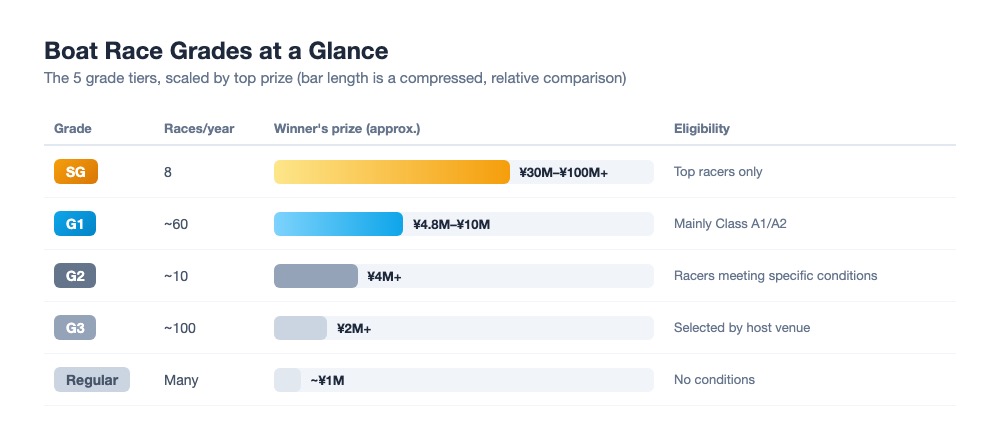
Boat racing has the following grade tiers.
| Grade | Races/year | Winner's prize (approx.) | Eligibility |
|---|---|---|---|
| SG | 8 | ¥30M–¥100M+ | Top racers only |
| G1 | ~60 | ¥4.8M–¥10M | Mainly Class A1/A2 |
| G2 | ~10 | ¥4M+ | Racers meeting specific conditions |
| G3 | ~100 | ¥2M+ | Selected by host venue |
| Regular | Many | ~¥1M | No conditions |
The 8 SG (Special Grade) races
The 8 SG races held each year:
- Boat Race Classic (March)
- Boat Race All-Star (May)
- Grand Champion (June)
- Ocean Cup (July)
- Boat Race Memorial (August)
- Boat Race Derby (October)
- Challenge Cup (November)
- Grand Prix / Grand Prix Series (December)
Character:
- The nation's top racers gather
- High prize money
- High fan attention
How grade races differ from regular races
1. Racer skill level is uniform
In a regular race:
- A mix of Class A1 through B2
- A large gap in ability
- A Class A1 racer in lane 1 signals a solid race
In a grade race:
- Nearly everyone is Class A1
- A small gap in ability
- Even lane 1 isn't a sure thing
The effect:
- Predictions become harder
- Payouts tend to run higher
- Almost anyone can win depending on how the race develops
2. The motor lottery matters more
In grade races, since the gap in racer ability is small, motor performance often decides the outcome.
Regular races: Gap in racer ability > gap in motor performance
Grade races: Gap in racer ability ≈ gap in motor performance
How to adjust: Always check the motor's 2nd-place-or-better rate. A racer who drew a motor at 40%+ deserves extra attention.
3. Some racers race aggressively to qualify
In grade races, some racers push harder than usual just to advance out of the qualifying round.
Approximate qualifying cutoff:
- A points average around 5.50–6.00
- Especially intense on days 1–3
What "racing aggressively" means: Pushing harder than usual in an attempt to secure a qualifying spot.
The effect:
- More aggressive starts
- More overtakes
- Higher risk of an accident (capsize or falling overboard)
5 strategies for winning on grade races
Strategy 1: Bet differently in qualifying vs. the finals
Qualifying round (days 1–4) character:
- Racers are hungry for points
- More racers pushing beyond their usual limits
- More prone to upsets
Semifinal/final character:
- Only the top-performing racers remain
- Lane 1 tends to be strong (occupied by a racer who's already won through)
- Relatively predictable results
How to adjust your bets:
| Round | Recommended strategy |
|---|---|
| Qualifying (days 1–4) | Target longshots, spread wide |
| Semifinal | Anchor lane 1, spread moderately |
| Final | Anchor lane 1, narrow and commit |
Strategy 2: Check the points average
In grade races, a racer's points average becomes an important indicator.
What points average means: The average score earned based on finishing position across races.
How points are scored:
- 1st: 10 pts
- 2nd: 8 pts
- 3rd: 6 pts
- 4th: 4 pts
- 5th: 2 pts
- 6th: 1 pt
How to use it:
- High points average → strong odds of qualifying
- Low points average → may be pushing harder than usual
Targeting a racer pushing hard: A racer sitting right on the qualifying cutoff on the final day of the qualifying round is likely to race more aggressively.
Strategy 3: Watch the Dream Race
What the Dream Race is: Race 12 on day 1 of a grade race, featuring especially notable racers from the field.
Character:
- Lane assignments are often decided by fan vote
- Lane 1 isn't necessarily the most popular racer
- Racer motivation runs high
What to target:
- Popularity and ability don't always line up here
- A real opportunity for a longshot
Strategy 4: Pay attention to local racers
The local racer's advantage:
- Deep knowledge of the water conditions
- Support from local fans
- High motivation
Situations especially worth watching:
- A G1 anniversary race is held at the racer's home venue
- A local ace is entered
What the data shows about the home advantage: Some data suggests local racers win at a rate roughly 5–10% higher than visiting racers.
Strategy 5: Take it easy on day 1
Why day 1 is hard to predict:
- Motor tuning is still an unknown
- Racer form isn't clear yet
- Lane approach isn't predictable yet
Recommended approach:
- Bet small and observe on day 1
- Bet more confidently from day 2 onward, once you have data
- Watch day 1's races to get a feel for tendencies
Watch out for these grade-race traps
Trap 1: Overbetting on the popular pick
Grade races draw high attention, and betting money tends to concentrate on popular racers.
The result:
- The popular racer's odds drop too low
- Even a hit pays out little
- Risk of a break-even hit (winning but still losing money)
How to avoid it: If you're anchoring around a popular racer, target longshots for the other spots.
Trap 2: Assuming lane 1 is "safe" just because it's SG
Do you assume "it's all top racers, so lane 1 must be solid"?
What the data actually shows: SG races' lane-1 win rate runs about the same as regular races, or even slightly lower.
Why:
- Every other racer is also top-tier
- Starts tend to be more aggressive
- A weak start from the inside can get punished immediately
Trap 3: Going all-in only on the final
"I'll win it all back on the final race!" is a dangerous mindset.
Character of the final:
- Odds tend to be distorted (money concentrates on the popular pick)
- Trying to recover everything in one race often leads to a big loss
The right approach: Build your profit gradually, starting from the qualifying round.
How Ryujin Radar handles grade races
Ryujin Radar provides its usual predictions for grade races as well.
Things to keep in mind:
- Since the gap in racer ability is small, prediction difficulty rises in grade races
- The confidence score may run lower than usual
- Place and Trio bets, which prioritize hit rate, are a good approach here
Summary
5 strategies for winning on grade races:
- Bet differently in qualifying vs. the final — qualifying is more volatile, the final tends to be more predictable
- Check the points average — spot racers likely to push hard
- Watch the Dream Race — a real opportunity for a longshot
- Pay attention to local racers — their water knowledge is a real edge
- Take it easy on day 1 — commit once you have the data
Grade races are hard, but understanding their character opens up real opportunities. Give this a try the next time an SG or G1 comes around.