"I want to hit my picks in SG races, but what should I actually base my predictions on?"
SG races, the pinnacle of boat racing, are held only 8 times a year. The nation's top Class A1 racers gather for these events, where the competition looks nothing like a regular race.
This article walks through the 2026 SG race calendar and breaks down each race's character and betting strategy.
What is an SG race? — The 8 biggest races in boat racing
SG stands for "Special Grade," the highest grade in boat racing.
SG race basics
- Races per year: 8
- Eligibility: Top racers, mostly Class A1
- Winner's prize: ¥30 million to over ¥100 million
- Duration: 6 days per race (qualifying → semifinal → final)
Only a handful of the roughly 1,600 licensed boat racers nationwide ever qualify for an SG race. That's exactly why the competition level — and the difficulty of predicting it — is so high.
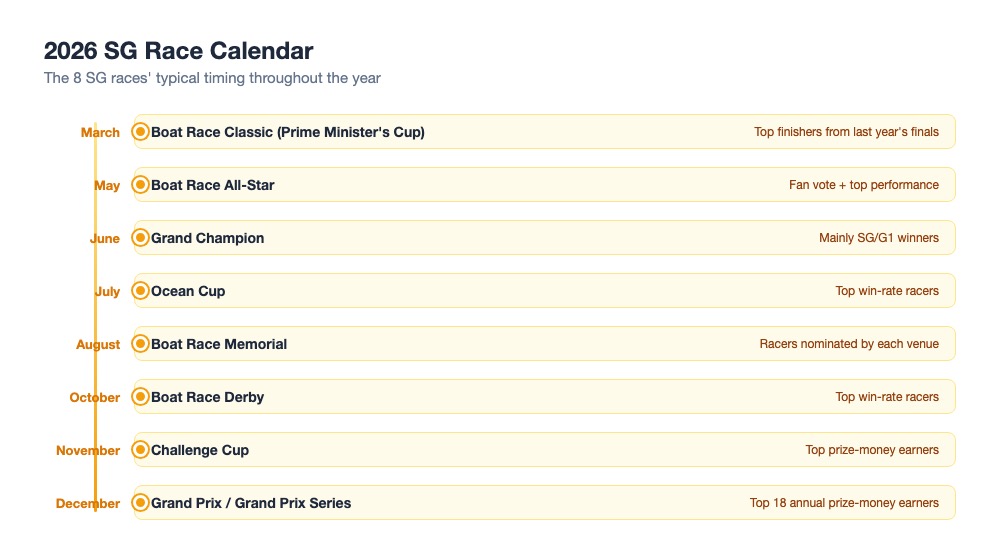
2026 SG race calendar
Below is the 2026 SG race lineup. Check the official site for the latest exact dates and venues.
| No. | Race | Typical timing | Qualification |
|---|---|---|---|
| 1 | Boat Race Classic (Prime Minister's Cup) | March | Top finishers from last year's finals |
| 2 | Boat Race All-Star | May | Fan vote + top performance |
| 3 | Grand Champion | June | Mainly SG/G1 winners |
| 4 | Ocean Cup | July | Top win-rate racers |
| 5 | Boat Race Memorial | August | Racers nominated by each venue |
| 6 | Boat Race Derby | October | Top win-rate racers |
| 7 | Challenge Cup | November | Top prize-money earners |
| 8 | Grand Prix / Grand Prix Series | December | Top 18 annual prize-money earners |
Note: Check the official boat racing site for exact dates and venues.
Each SG race's character and how to bet on it
1. Boat Race Classic (March)
The first SG of the year, featuring racers who performed well the previous season. Early-year form tends to carry straight through.
Strategy:
- Watch racers who were hot in the back half of the previous year
- At venues with new motors, spotting the "lucky" motor matters
- Focus heavily on exhibition times in days 1–2
2. Boat Race All-Star (May)
Since entrants are chosen by fan vote, this race has a festival-like atmosphere with popular racers front and center. The Dream Race lineup is filled with the top vote-getters.
Strategy:
- Odds tend to skew toward popular racers, opening up longshot opportunities
- In the Dream Race, popular racers face off against each other and odds tend to split
- Remember: "popularity" and "ability" don't always align
3. Grand Champion (June)
Entrants are mainly selected from SG/G1 winners — a field of genuinely elite racers.
Strategy:
- With such a high overall caliber of racer, the ability gap between competitors is the smallest of any SG
- Inside wire-to-wire win rate tends to be lower than in regular races
- Races often come down to motor performance, making exhibition data analysis key
4. Ocean Cup (July)
Held in summer, when temperature and humidity significantly affect motor performance.
Strategy:
- Rising temperatures tend to reduce motor output, making overtakes harder to land
- Inside-pass and overtake-and-pass patterns become more common
- Local racers tend to know how to handle the heat — worth checking
5. Boat Race Memorial (August)
A battle of local representatives, with each venue nominating its own entrant. Motivation runs high as racers compete for their home venue's pride.
Strategy:
- Locally nominated racers know the water intimately and are often skilled at turns
- The "local racer × home venue" fit is an especially important data point
- Since each venue's ace-level racer is present, the semifinals onward can be more predictable
6. Boat Race Derby (October)
Positioned as the year's ultimate showdown among top win-rate racers. Autumn conditions tend to stabilize motor performance, producing results that track closer to raw ability.
Strategy:
- With top annual win-rate racers gathered, the inside lane's reliability is relatively high
- Motors stabilize in autumn, favoring a speed-focused race
- Qualifying-round points races get fierce — don't overlook a racer pushing hard to secure a spot
7. Challenge Cup (November)
Featuring top prize-money earners, this race functions as a warm-up with Grand Prix qualification on the line.
Strategy:
- Racers near the Grand Prix qualification cutoff tend to race aggressively
- Racers who've already secured their Grand Prix spot may use this race to test motor adjustments instead
- Reading each racer's "stakes" in the race is key to predicting it
8. Grand Prix / Grand Prix Series (December)
Featuring the year's top 18 prize-money earners, this is the pinnacle showdown of the boat racing world. The winner's prize exceeds ¥100 million, and it's the year's grand finale.
Strategy:
- The trial (qualifying) round splits racers into 2 groups, with the top 3 from each advancing to the final
- The final is a single winner-take-all race among 6 racers, where the lane draw can decide everything
- The Grand Prix Series (for racers ranked 19th and below) runs alongside it and is comparatively easier to predict
3 things to watch when predicting SG races
1. Everyone is Class A1 — the "skill gap" nearly disappears
In regular races, a Class A1 racer in lane 1 gives you a strong expectation of a wire-to-wire win. In SG races, everyone is Class A1, and lane 1's wire-to-wire rate tends to run 5–10% lower than in regular races.
Motor performance and same-day start power matter more than raw lane advantage.
2. The motor lottery has a big impact
SG races use motors assigned to the host venue via a lottery. Racers have to adapt to unfamiliar motors in a short time, which favors racers skilled at tuning.
Data worth checking:
- Motor 2nd- and 3rd-place rates
- Exhibition time and straightaway time
- Time changes from the previous day (a sign of tuning effectiveness)
3. Assess the home-venue advantage
Local racers, or racers who specialize in the host venue's water conditions, gain a real advantage in course positioning and turns. This local edge is especially significant in a locally-nominated race like the Memorial.
Using Ryujin Radar to tackle SG races
Ryujin Radar provides data-driven predictions for SG races too.
Tips for using it
- Check the turn predictions first — in SG races, the battle at the first turn often decides the outcome, making turn-prediction data especially valuable
- Use the AI's data analysis — an AI prediction combining racer, motor, exhibition, and weather data helps you gauge the race's character
- Use the Upset Index as a guide — SG races tend to be volatile, so on races with a high Upset Index you can widen your bet spread accordingly
SG races are hard, but with data on your side, there's real opportunity. Enjoy the 2026 SG season together with Ryujin Radar.
Check Ryujin Radar's SG race predictions → https://boat-ai.jp/
Tags: #SGBoatRacing2026 #GrandPrixPredictions #AllStarPredictions #SGRaceSchedule #BoatRacing #AIPrediction #RyujinRadar