Introduction
"Boat racing is hard... isn't there an easier race to predict?"
If that's you, planned races are worth knowing about.
A planned race is a race with special rules built into its lineup composition. Because the conditions are set up to favor lane 1 winning, these races are much easier for beginners to predict.
This article covers the types of planned races and how to use them.
What is a "planned race"?
How it works
A regular race:
- The lineup (entrants) is determined by lottery or performance ranking
- Lane 1 isn't necessarily favored
A planned race:
- The lineup has special rules applied
- Conditions are set up to favor lane 1
- Results tend to be predictable
Why do planned races exist?
The purpose:
- To give beginner fans races that are easier to predict
- To boost ticket sales
- To showcase boat racing's appeal
The benefit for the venue:
- Beginners can enjoy the race
- Helps build repeat visitors
Types of planned races
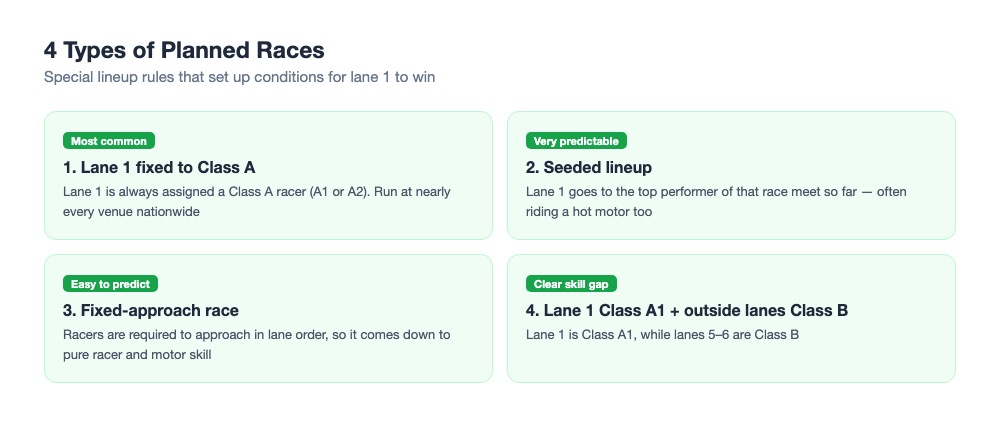
Type 1: Lane 1 fixed to Class A
The rule: Lane 1 is always assigned a Class A racer (A1 or A2).
Character:
- The most common type of planned race
- Lane 1's win rate runs higher than normal
- Held at nearly every venue nationwide
Examples:
- A "fixed approach" race 1, etc.
- Only lane 1 is Class A, lanes 2–6 are Class B
Type 2: Seeded lineup
The rule: Lane 1 goes to the top performer of that race meet so far.
Character:
- Lane 1 goes to a racer in good form
- Their motor is also often performing well
- Tends to produce a very predictable result
Examples:
- A featured race in the back half of qualifying
- Lane 1 goes to the top points-average racer
Type 3: Fixed-approach race
The rule: Racers are required to approach in lane order (no jockeying for position).
Character:
- No pre-race jockeying for lane position
- The lane-1 racer is guaranteed lane 1
- Easier to predict
The benefit: No need to predict lane approach — the race comes down purely to racer and motor ability.
Type 4: Lane 1 Class A1 + outside lanes Class B
The rule: Lane 1 is Class A1, while lanes 5–6 are Class B.
Character:
- A clear gap in ability
- Lane 1 has an overwhelming advantage
- Lane 1's win rate can exceed 70%
Examples:
- Races named "First Battle," "Early Bird Race," etc.
When planned races are held
By time of day
Early morning (races 1–2):
- The most common time for planned races
- Set up to be predictable for beginners
Midday (races 5–8):
- Fewer planned races
- Usually a standard lineup
Final races (11–12):
- Semi-main and main races
- Sometimes a seeded lineup
By day of the race meet
Day 1:
- More planned races
- Aimed at drawing in fans
Mid-meet (days 3–4):
- Seeded lineups based on results so far
- Lane 1 goes to a racer in good form
Final day:
- Semifinal and final races
- Not "planned" per se, but lane 1 is still favored
How to spot a planned race
Method 1: Check the "notes" column in the race program
The race program will note things like "fixed approach" or "Class A seeded."
Method 2: Check the race name
Planned races often get a distinctive name.
Common race names:
- "First Battle"
- "Morning Special"
- "Sunrise Race"
- "This Is the One!"
- "Break Time"
Method 3: Check races 1 and 2
Early morning tends to have more planned races:
- Race 1: fixed approach, lane 1 Class A
- Race 2: a similar setup
Start by checking the lineup for races 1 and 2.
Method 4: The venue's official site
Each boat racing venue's official site publishes information about its planned races.
What you can find:
- The planned race's name
- Rule details
- Which race numbers it applies to
How to bet on a planned race
Approach 1: Anchor around lane 1
The basic strategy: Build your bet around lane 1 finishing 1st.
Example bets:
- Win: lane 1
- Place: lane 1
- Exacta: 1-all
- Trifecta: 1-all-all
Approach 2: Play it safe with Place
The idea: Even if lane 1 doesn't win, it tends to still finish top 2 in a planned race.
The upside:
- High hit rate
- Less risk of a big loss
- Sustainable for beginners
The downside:
- Lower payouts (roughly ¥110–150)
Approach 3: Focus your bet on 2nd place and below
The idea: Assume lane 1 takes 1st, and focus your prediction on 2nd and 3rd.
What to target:
- A Class A racer in lane 2 or 3
- A racer with a strong motor
- A racer with a good exhibition time
Example bets:
- Trifecta: 1-2-3, 1-2-4, 1-3-2, 1-3-4
- Trio: 1-2-3, 1-2-4, 1-3-4
Things to watch out for with planned races
Caution 1: Low payouts
Betting concentrates on the favorite: Since planned races are known to be predictable, betting money concentrates on lane 1.
The result:
- Win odds around 1.2–1.5x
- Risk of a break-even hit (winning but still losing money)
How to handle it:
- Avoid Win and Place bets
- Target Trio/Trifecta with a narrowed field to get a real payout
Caution 2: It's not a guarantee
Even in a planned race, lane 1 can still lose:
- If the motor is underperforming
- If the racer is out of form
- Due to an accident (capsize or falling overboard)
Don't over-trust it: Don't assume "it's a planned race, so it's guaranteed to hit."
Caution 3: Not every race in the day is planned
An easy mistake: Race 1 might be a planned race, while race 3 onward reverts to a standard lineup.
How to check: Always check the lineup for each individual race.
Combining Ryujin Radar with planned races
Using Ryujin Radar even on planned races
Use Ryujin Radar's prediction to:
- Narrow your 2nd- and 3rd-place candidates
- Check the confidence score
- Check the motor data
Planned race × high confidence
The strongest combination:
- Lane 1 is favored by the planned race's rules
- Ryujin Radar's confidence score is also high
- When both line up, the race is often very predictable
A beginner-friendly approach to planned races
Step 1: Check races 1 and 2
Start by checking whether the early races are planned races.
Step 2: Check lane 1's data
- Racer class (A1 or A2)
- Motor 2nd-place-or-better rate
- Exhibition time
Step 3: Bet Place or Trio
- Place: lane 1 (prioritizing hit rate)
- Trio: 1-2-3, 1-2-4, etc. (targeting a real payout too)
Step 4: Track your results
Whether you win or lose, record the result and use it going forward.
Summary
Key points on planned races:
- Conditions are set up to favor lane 1: fixed Class A, seeded lineups, and more
- Common in the early morning (races 1–2): check the early races first
- Great for beginners: easier to predict, higher hit rate
- Lower payouts: watch for break-even hits, target Trio/Trifecta for a real return
Planned races are the perfect entry point for a boat racing beginner to experience the joy of actually hitting a pick.
Start by learning the basics of ticket buying through planned races, and gradually work your way up to harder races.