When you decide "I'll bet on Kiryu today," do you actually know Kiryu's character as a venue?
Boat racing is held at 24 venues nationwide, but winning patterns differ completely from venue to venue. Some venues heavily favor the inside lane, while others give outside racers a real shot at winning.
Betting without understanding these differences is like walking an unfamiliar city without a map.
This article is a complete guide to all 24 boat racing venues — their character, lane-1 win rate, and which venues favor the inside vs. the outside — combined with Ryujin Radar's data analysis to give you a strategy for each venue.
What actually differs between venues?
Here's what varies from venue to venue.
1. Water type (fresh, salt, or brackish)
- Fresh water: lower buoyancy, favors lighter racers
- Salt water: higher buoyancy, weight differences matter less
- Brackish water: a mix of fresh and salt, conditions shift with the tide
2. Water surface size
- A wide water surface: overtakes and inside passes are easier, favors outside lanes
- A narrow water surface: favors the inside lane, wire-to-wire wins land more often
3. Wind effects
- A windy venue: harder starts, more prone to volatility
- A calm venue: standard theory holds, favors lane 1
4. Tides (salt-water and brackish venues only)
- High tide: higher water level, easier to build speed
- Low tide: lower water level, turning ability matters more
These factors combine to shape each venue's individual character.
Ranking all 24 venues by "inside-lane advantage"
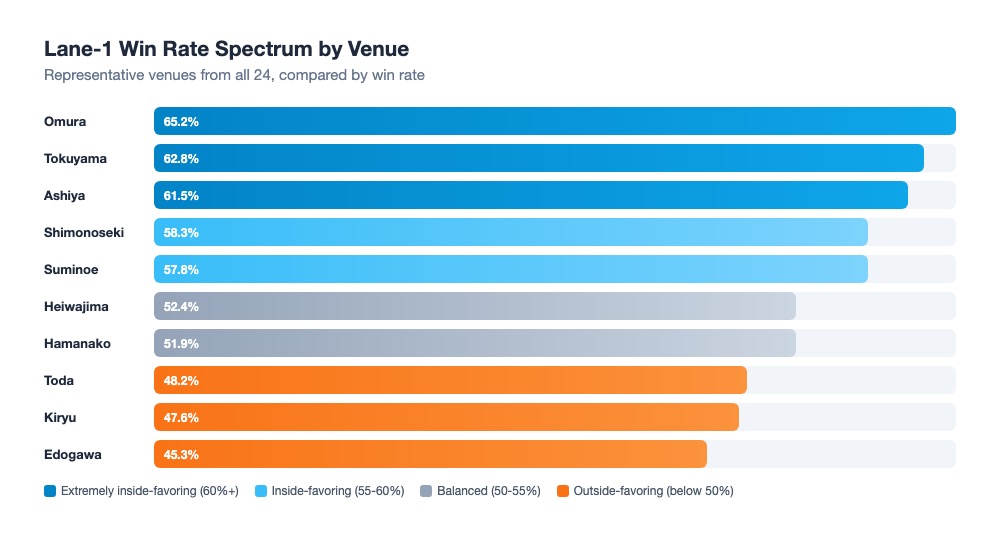
Using Ryujin Radar's analysis data, here are all 24 venues ranked by lane-1 win rate, highest to lowest.
Extremely inside-favoring (lane-1 win rate 60%+)
#1: Omura (Nagasaki) — lane-1 win rate 65.2%
Character:
- Japan's strongest inside-favoring venue
- Calm water, minimal wind effects
- A short distance to the first turn mark, making wire-to-wire wins easy to land
Strategy:
- If lane 1's racer has real ability, it's about as close to a sure thing as it gets
- Targeting 2nd/3rd with outside lanes is an effective approach
- For Trifecta, anchoring 1st with a flow bet is more efficient than a box bet
Ryujin Radar's Upset Index tendency: Favorite friendly
#2: Tokuyama (Yamaguchi) — lane-1 win rate 62.8%
Character:
- Calm water facing the Seto Inland Sea
- Minimal wind effects, lane 1 has an overwhelming advantage
- Motor performance differences rarely show up
Strategy:
- Build your bet assuming lane 1 wins wire-to-wire
- Target Trio bets around 2nd/3rd
- Volatile races are rare here, so avoid targeting longshots
Ryujin Radar's Upset Index tendency: Favorite friendly
#3: Ashiya (Fukuoka) — lane-1 win rate 61.5%
Character:
- Salt water, calm conditions
- A short distance to the first turn mark
- Lane 1 is favored, but lane 4 can also be worth targeting depending on the motor
Strategy:
- A lane-1-anchored Trifecta is the basic approach
- Watch outside lanes with a motor 2nd-place-or-better rate of 40%+
- Days with wind of 5m or more can turn volatile
Ryujin Radar's Upset Index tendency: Favorite friendly
Inside-favoring (lane-1 win rate 55–60%)
Shimonoseki (Yamaguchi) — lane-1 win rate 58.3%
Character:
- Significant tidal swings
- Lane 1 is favored at low tide, outside lanes have more of a shot at high tide
- Motor performance gaps have a big effect
Strategy:
- Check the tide chart (anchor lane 1 at low tide)
- At high tide, target racers with a fast exhibition time
- Check the gap in motor 2nd-place-or-better rate
Ryujin Radar's Upset Index tendency: Standard
Suminoe (Osaka) — lane-1 win rate 57.8%
Character:
- Hosts night races (after sunset)
- Fresh water, calm conditions
- Hosts many corporate cups and SG races, drawing Class A racers
Strategy:
- Races with many Class A racers tend to be predictable
- Wind weakens during night races, favoring lane 1
- A prediction weighted toward racer win rate works well
Ryujin Radar's Upset Index tendency: Favorite friendly
Balanced (lane-1 win rate 50–55%)
Heiwajima (Tokyo) — lane-1 win rate 52.4%
Character:
- Salt water, somewhat prone to volatility
- Wind has a significant effect
- Lanes 4–6 can win outright depending on motor performance
Strategy:
- Check wind speed and direction (be cautious of a headwind)
- Weight racers with a motor 2nd-place rate of 40%+
- Target a longshot when the Upset Index shows "Upset alert (high)"
Ryujin Radar's Upset Index tendency: Standard
Hamanako (Shizuoka) — lane-1 win rate 51.9%
Character:
- Brackish water (a mix of fresh and salt)
- Water conditions shift with the tide
- Often windy, making starts difficult
Strategy:
- Check both the tide and wind direction
- Weight racers with a fast exhibition time
- Overtakes and inside passes land relatively often
Ryujin Radar's Upset Index tendency: Standard
Outside-favoring (lane-1 win rate 50% or below)
Toda (Saitama) — lane-1 win rate 48.2%
Character:
- Japan's narrowest boat racing venue
- The first turn mark is extremely close
- "Waiting on the inside" doesn't work here — it comes down to the start
Strategy:
- Prioritize the start-exhibition time above all else
- Avoid racers who looked close to a flying start in the exhibition
- Inside passes from lanes 2–4 land often
Ryujin Radar's Upset Index tendency: Standard to upset alert (high)
Edogawa (Tokyo) — lane-1 win rate 45.3%
Character:
- Japan's most volatile boat racing venue
- A river current, plus significant wind effects
- A "cursed water" where standard theory doesn't hold
Strategy:
- Weight same-day conditions more heavily than historical data
- Always check the exhibition run
- Target local racers who specialize in Edogawa's conditions
Ryujin Radar's Upset Index tendency: Upset alert (high)
Kiryu (Gunma) — lane-1 win rate 47.6%
Character:
- High elevation, thinner air
- Motor output runs lower than normal
- Windy year-round
Strategy:
- Prioritize wind speed and direction above all else
- Lighter racers have an advantage
- Target racers skilled at motor tuning
Ryujin Radar's Upset Index tendency: Standard to upset alert (high)
Regional tendencies
Kanto region (Toda, Edogawa, Heiwajima, Kiryu, Tamagawa)
- Generally prone to volatility
- Wind has a significant effect
- Standard theory often doesn't hold
Strategy: Weight the exhibition run heavily, stay mindful of upset potential
Chubu-Tokai region (Hamanako, Gamagori, Tokoname, Tsu)
- Mostly balanced venues
- Affected by both wind and tide
- Motor performance matters
Strategy: Check the motor 2nd-place-or-better rate, and weigh both sides for a balanced bet
Kinki region (Biwako, Suminoe, Amagasaki)
- Relatively predictable
- Mostly fresh water
- Racer ability tends to translate directly into results
Strategy: Weight racer win rate heavily and lean toward the favorite
Chugoku-Shikoku region (Miyajima, Tokuyama, Shimonoseki, Marugame, Kojima, Naruto)
- Many inside-favoring venues
- Calm water facing the Seto Inland Sea
- Lane 1 is highly reliable
Strategy: Bet around a lane-1 anchor with a favorite-focused approach
Kyushu region (Wakamatsu, Ashiya, Fukuoka, Karatsu, Omura)
- The region with the strongest inside advantage
- Mostly calm-wind venues
- Lane 1's wire-to-wire rate runs high
Strategy: A lane-1-anchored favorite-focused bet; Trio and Quinella bets are efficient here
How Ryujin Radar uses venue-specific data
Ryujin Radar analyzes each venue's character and factors it into its predictions.
1. Reflects each venue's Upset Index tendency
- Omura, Tokuyama → low upset chance, favorite friendly
- Edogawa, Toda → upset alert (high), prone to volatility
- All others → a standard upset tendency
2. Factors venue-specific lane-1 win rate into the AI score
At inside-favoring venues, lane 1's AI score runs higher accordingly.
3. Automatically pulls in wind and tide data
Same-day weather conditions are pulled in automatically and used to calculate the Upset Index.
Real examples: predicting with venue character in mind
Case 1: Omura (extremely inside-favoring)
Race conditions:
- Lane 1: win rate 6.3, motor 2nd-place rate 38%
- Lane 4: win rate 6.8, motor 2nd-place rate 52%
A generic prediction: lane 4 looks stronger on both ability and motor
A prediction that accounts for Omura's character:
- Omura's lane-1 win rate is an extreme 65% — an overwhelmingly inside-favoring venue
- Lane 1 is likely to win wire-to-wire unless their form is unusually poor
- Lane 1 should be your anchor
Result: Lane 1 won wire-to-wire (the prediction hit)
Case 2: Edogawa (a volatile water surface)
Race conditions:
- Lane 1: win rate 6.5, motor 2nd-place rate 45%
- Wind: headwind 8m
A generic prediction: favor lane 1
A prediction that accounts for Edogawa's character:
- Edogawa's lane-1 win rate is a low 45%
- Strong wind makes the start difficult
- An outside racer is a real contender here too
Result: Lane 4 won via an overtake (a high-payout hit)
Summary: understand venue character to raise your win rate
Here are the key strategies for all 24 boat racing venues.
Inside-favoring venues (Omura, Tokuyama, Ashiya, etc.)
- A lane-1-anchored favorite-focused bet works well
- Target 2nd/3rd with Trio and Quinella bets
- Volatile races are uncommon
Balanced venues (Heiwajima, Hamanako, etc.)
- Weight motor 2nd-place-or-better rate and exhibition time heavily
- Check wind speed and tide
- Weigh both sides for an overall judgment
Outside-favoring venues (Edogawa, Toda, Kiryu, etc.)
- Always check the exhibition run
- Prioritize wind speed and direction above all else
- Stay mindful of upset potential to target a bigger payout
How to use Ryujin Radar
- Check each venue's "Upset Index"
- Keep each venue's lane-1 win rate data in mind
Understanding each venue's character reliably improves your prediction accuracy. Put venue-specific strategy into practice together with Ryujin Radar!
Check Ryujin Radar's venue-specific data now → https://boat-ai.jp/