Introduction
Looking at a bet like "1-2-3" or "4-5-6," could you explain why that particular combination?
Boat racing has a concept called "suji" — a theory of how a race tends to unfold. Understanding suji lets you build your bets by imagining how the race will actually play out, instead of just picking numbers.
This article covers everything from the basics of suji betting to how to apply it in practice.
What is a suji bet?
Definition
A suji bet is a bet built around boat racing's theory of race development.
In boat racing, the battle for the first turn mark on lap 1 (the "1 mark") essentially decides the race. And there's a general rule: which boat takes the lead at that turn strongly influences the pattern of finishers behind it.
Why does suji exist?
Boat racing courses turn counterclockwise. Going around the first mark:
- Inside boats: have a shorter turning arc and can turn first
- Outside boats: have a longer turning arc and tend to fall behind
Because of this, the winning boat's lane determines which boats are likely to finish 2nd and 3rd.
Basic suji patterns
Inside wire-to-wire suji (when lane 1 wins)
The most basic pattern — lane 1 nails the start and wins wire-to-wire.
| Development | Suji combination | Reason |
|---|---|---|
| Lane 1 wire-to-wire | 1-2, 1-3 | The inside lanes 2 and 3 follow naturally |
| Lane 1 wire-to-wire (inside pass) | 1-4, 1-2-4 | Lane 4 slips inside for 2nd |
Typical bets:
1-2-3 (the classic favorite combination)
1-2-4 (an inside-pass pattern)
1-3-2 (lane 3 ahead of lane 2)
1-3-4
Key points:
- When lane 1 wins wire-to-wire, the outside lanes 5 and 6 generally don't factor in
- "1-2-6" and "1-5-6" are against the suji (combinations that are less likely to come in)
- The suji listed here are examples for thinking through race development. Combinations you leave out of your candidates can still come in
Overtake suji (when an outside lane wins)
Lanes 3–6 attack from the outside and take the first turn.
Lane 3 overtake
| Development | Suji combination | Reason |
|---|---|---|
| Lane 3 overtake | 3-4, 3-5 | Outside boats follow the overtaking momentum |
| Lane 3 overtake-and-pass | 3-1, 3-4-1 | Lane 3 slips inside and takes the lead |
Typical bets:
3-4-5 (a pure overtake development)
3-4-1 (outside overtake + inside holds on)
3-1-4 (an inside-pass development)
Lane 4 overtake
| Development | Suji combination | Reason |
|---|---|---|
| Lane 4 overtake | 4-5, 4-6 | Boats that swung wide together follow |
| Lane 4 overtake | 4-5-6 | A complete outside overtake sweep |
Typical bets:
4-5-6 (a big outside overtake)
4-5-1 (overtake + inside holds on)
4-3-5 (lane 3 holds for 2nd)
Inside-pass suji
The inside boat takes the lead at the turn, but gets passed on the inside.
| Development | Suji combination | Reason |
|---|---|---|
| Lane 2 inside pass | 2-1, 2-3 | Passes lane 1 on the inside |
| Lane 4 inside pass | 4-1, 4-2 | Looks like an overtake but passes on the inside |
Key points:
- An inside pass is a signature move of racers skilled at turning
- When an inside pass lands, the original inside boat often still holds on for 2nd
Suji quick-reference table
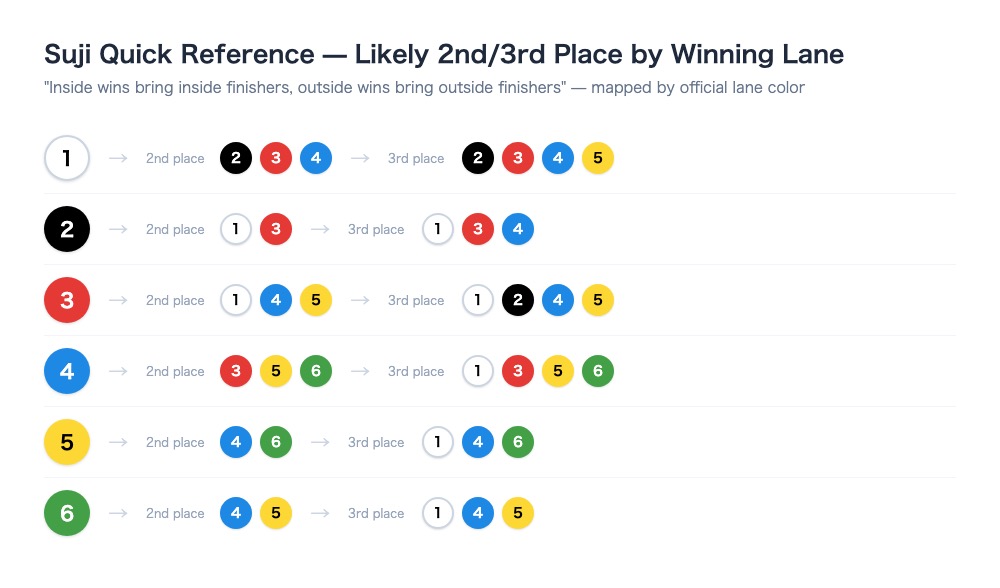
A handy suji quick-reference table worth memorizing.
| 1st | Likely 2nd (suji) | Likely 3rd |
|---|---|---|
| Lane 1 | 2, 3, 4 | 2, 3, 4, 5 |
| Lane 2 | 1, 3 | 1, 3, 4 |
| Lane 3 | 1, 4, 5 | 1, 2, 4, 5 |
| Lane 4 | 3, 5, 6 | 1, 3, 5, 6 |
| Lane 5 | 4, 6 | 1, 4, 6 |
| Lane 6 | 4, 5 | 1, 4, 5 |
The rule of thumb:
- Inside lane wins → inside lanes tend to follow
- Outside lane wins → outside lanes tend to follow
Against the suji (unlikely combinations)
Understanding suji also tells you which combinations are unlikely to come up.
Outside boats coming in despite an inside wire-to-wire (against the suji)
❌ 1-5-6 (rare for lanes 5 and 6 to finish 2nd/3rd behind a lane-1 wire-to-wire win)
❌ 1-6-5
❌ 1-6-2
Inside boats coming in despite an outside overtake (against the suji)
❌ 4-1-2 (rare for lanes 1 and 2 to follow behind a lane-4 overtake win)
❌ 5-1-2
❌ 6-1-2
When against-the-suji results happen:
- A highly chaotic race
- A capsize or a racer falling overboard
- A wildly scattered start
Against-the-suji results pay out big, but they're hard to target deliberately.
How to bet using suji
Strategy 1: Narrow your bets with suji
Use suji to trim down your bet combinations
Example: a race where lane 1 looks likely to win
Every combination: 1-234-234 = 6 combinations
Narrowed by suji: 1-2-3, 1-2-4, 1-3-2, 1-3-4 = 4 combinations
Cutting just 2 combinations already improves your return rate.
Strategy 2: Choose a suji from your predicted race development
Use the start exhibition as a reference to predict the development, and pick your suji accordingly
[Predicted development]
- Exhib. ST: lane 1 slow
- Exhib. ST: lane 4 fast
→ May overtake in the race
→ Lane-4 overtake suji

[Bets]
4-5-6 (overtake)
4-5-1 (inside holds on)
4-3-5 (lane 3 holds 2nd)
The start exhibition is only a reference. The approach and start in the actual race can differ from the exhibition, so don't treat the exhibition's lineup or ST as the actual race lineup.
Strategy 3: Split your bankroll between the main line and a hedge
Put the suji combinations as your main line, and against-the-suji combinations as a hedge
[Main line (suji combinations)] 80% of bankroll
1-2-3: ¥1,000
1-2-4: ¥800
1-3-2: ¥600

[Hedge (against the suji)] 20% of bankroll
1-5-4: ¥300
1-6-4: ¥300
Suji tendencies by venue
Suji tendencies differ from venue to venue.
Venues where an inside wire-to-wire suji is common
| Venue | Lane 1 win rate | Character |
|---|---|---|
| Omura | ~60% | Japan's strongest inside advantage |
| Ashiya | ~58% | Calm water favors the inside |
| Tokuyama | ~57% | Calm water conditions |
→ The 1-2-3 and 1-2-4 suji combinations land often
Venues where an overtake suji is common
| Venue | Character |
|---|---|
| Toda | Narrow water favors overtaking |
| Heiwajima | Tidal effects work against the inside |
| Edogawa | Difficult water conditions make things tough for the inside |
→ The 3-4-5 and 4-5-6 suji combinations show up often
Combining AI with suji
Combining Ryujin Radar's predictions with suji theory sharpens your accuracy even further.
How to use it
-
Check the AI's prediction
- 1st predicted: lane 4
- 2nd predicted: lane 5
- 3rd predicted: lane 1
-
Check it against suji
- Lane 4 finishing 1st → the lane-4 overtake suji
- 4-5 matches the suji ✓
- 4-5-1 fits naturally as "overtake + inside holds on" ✓
-
A suji match raises your confidence
- AI prediction matches the suji → higher confidence
- AI prediction goes against the suji → treat with caution
FAQ
Q. Can I win just by betting the suji every time?
A. Suji alone won't guarantee a win.
Suji only represents "the pattern that tends to come up" — not a certainty. What matters just as much:
- Reading the race development with the start exhibition as a reference (the actual race's approach and start can differ from the exhibition)
- Racer ability and motor performance
- The effects of wind and waves
Think of suji as a tool for narrowing down your bets, not a complete answer on its own.
Q. Should I avoid betting against the suji?
A. It depends on the situation.
- Normally, prioritize the suji combinations
- In a race that looks likely to be volatile, hedge a small amount against the suji too
- Against-the-suji payouts are large, so it's a reasonable form of insurance
Q. How do I remember suji patterns?
A. Remember it as "the boats near the winner tend to follow."
- Lane 1 wins → lanes 2, 3 follow (nearby)
- Lane 4 wins → lanes 5, 6 follow (nearby)
- The exception is an inside pass, where an inside boat holds on
Summary
Key points on suji betting
-
Suji is a theory of race development
- If an inside lane wins, inside lanes tend to follow
- If an outside lane wins, outside lanes tend to follow
-
Use suji to narrow your bets
- Betting every combination is capital-inefficient
- Suji can trim your bets by 2–3 combinations
-
Against-the-suji results are rare
- "1-5-6" and "4-1-2" are uncommon
- They pay out big when they land, but they're hard to target
-
Factor in venue character
- Inside-favoring venues → lean on inside wire-to-wire suji
- Overtake-heavy venues → lean on overtake suji
-
Combining it with AI works well
- AI prediction matching the suji → higher confidence
- AI prediction going against the suji → proceed cautiously
Tags: #BoatRacing #SujiBetting #BettingStrategy #RaceDevelopment #DataAnalysis #AIPrediction #RyujinRadar