Introduction
"Can you actually make money on boat racing?"
Short answer: betting with no strategy will lose you money, guaranteed. But with data and strategy on your side, breaking a 100% return rate isn't out of reach.
This article breaks down "realistic ways to raise your return rate," based on an analysis of over 10,000 races.
What is return rate? First, understand "the 25% deduction wall"
Roughly 25% of every yen wagered on boat racing is taken as the operator's cut (deduction rate). The remaining 75% is returned to bettors.
| Item | Value |
|---|---|
| Return rate on total wagers | ~75% |
| Deduction rate | ~25% |
| Expected return rate on random betting | ~75% |
In other words, betting randomly turns ¥10,000 into ¥7,500 as a mathematical inevitability. Breaking a 100% return rate means overcoming this 25% handicap through strategy.
Why most people lose — 3 causes the data reveals
1. Betting on every race
Over 100 races run nationwide every day. Betting on all of them raises your total hit count, but betting even on low-expected-value races is the biggest reason bettors lose overall.
2. Changing your bet size based on emotion
"I just lost, so I'll double up to win it back." Repeat this pattern, and a single bad decision can wipe out an entire day's profit.
3. Spreading your combinations too thin
A 60- or 100-combination box bet on a Trifecta raises your hit rate, but leads to frequent break-even hits (winning the bet but still losing money).
5 strategies to raise your return rate
⭐ Strategy 1: Choose your races (the most important one)
The single biggest secret to breaking a 100% return rate is deciding which races NOT to bet on.
Race conditions worth targeting:
- A Class A1 racer in lane 1 with a motor 2nd-place rate of 40%+
- A calm-water venue that favors the inside lane (Omura, Tokuyama, Ashiya, etc.)
- A race with a clear gap in racer ability
Races to avoid:
- A race where every racer's ability is closely matched
- Bad weather or strong-wind conditions
- SG/G1 finals (closely matched skill levels make upsets more likely)
⭐ Strategy 2: Use different bet types strategically
| Bet type | Approx. hit rate | Best suited for |
|---|---|---|
| Place | 50–60% | Steadily building up profit on solid races |
| Quinella | 15–25% | Races with a clear anchor |
| Trio | 8–15% | A balanced approach targeting a mid-range payout |
| Trifecta | 3–8% | A big payout on races with a predictable development |
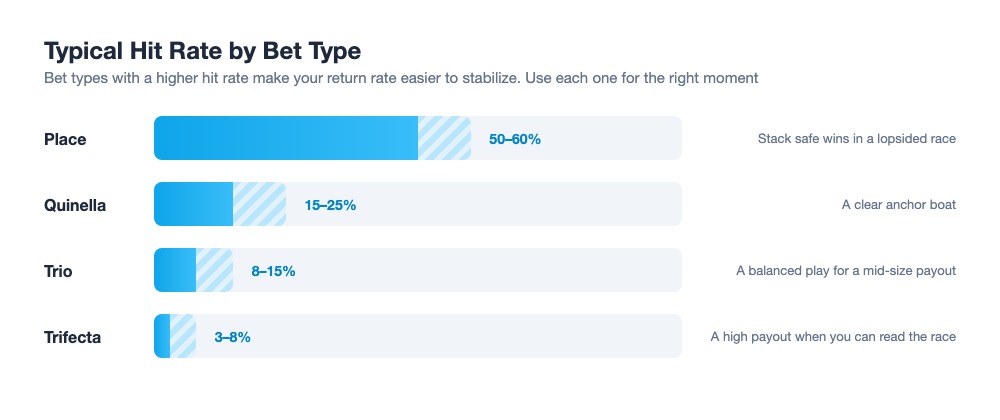
For a stable return rate, focusing on Place and Quinella, with Trio for the races you're most confident in, works well.
⭐ Strategy 3: Narrow your combination count
Rule of thumb: (combination count × ¥100) < the expected minimum payout
- Cap Trio bets at 6–10 combinations
- Cap Trifecta bets at 12–20 combinations
- Beyond that, the risk of a break-even hit rises sharply
⭐ Strategy 4: Manage your bankroll strictly
Recommended rules:
- Set a daily spending cap (e.g., ¥5,000)
- Fix your bet size per race (e.g., ¥500)
- Never chase a loss with a bigger bet
- Keep any profit separate from your principal
Removing emotion and running it mechanically is what drives long-term improvement in return rate.
⭐ Strategy 5: Use AI and data
If it takes a human 5–10 minutes to analyze a single race's entry list, checking all 100+ races in a day is simply impossible.
AI can analyze every race in seconds and extract only the statistically favorable ones. Judgment based on data — not "gut feeling" or "experience" — is what pushes return rate up.
How Ryujin Radar's AI predictions put race curation into practice
Ryujin Radar's AI predictions automate every one of the strategies above.
Why race curation is what drives return rate
The key is "race curation." Out of the 100+ races run each day, spotting the ones that match high-return patterns discovered through data mining is what pushes a return rate above 100%.
Rather than "participating in everything," it's about "participating only in the races you can win." That difference is what turns the 25% deduction rate around.
You can check the latest hit rate and return rate on the accuracy page.
Solid races vs. volatile races — using each one right drives your return rate
Characteristics of a solid race (favorite wins)
- A pattern where lane 1's Class A1 racer wins wire-to-wire
- Low payouts (Trio around ¥500–1,500) but a high hit rate
- ✅ Best suited for steadily building up profit with Place or Quinella bets
Characteristics of a volatile race (upset win)
- A close, tightly matched field
- Conditions with wind of 5m+ or high waves
- High payouts (a Trifecta can pay huge) but a low hit rate
- ✅ Best suited for a small stake on Trio or Trifecta bets
Tips for using each
Allocating 70% of your bankroll to solid races and 30% to volatile races is a well-balanced strategy. Build steady gains on the solid races while chasing bigger returns on the volatile ones.
⚠️ Targeting only volatile races leads to long stretches between hits, which can wear down your discipline. Winning experiences on solid races form the foundation for staying calm and level-headed.
Summary — what it takes to break a 100% return rate
| Do this | Don't do this |
|---|---|
| Curate your races carefully | Bet on every race |
| Narrow your combinations | Spread your box bet too thin |
| Fix your bet size | Chase losses with bigger bets |
| Decide based on data | Bet on emotion or gut feeling |
| Anchor around solid races | Chase only the huge payouts |
Breaking a 100% return rate isn't magic. It's the steady accumulation of race selection, combination discipline, and bankroll management overcoming the 25% deduction rate.
Ryujin Radar's AI predictions run this exact strategy automatically, every day.
👉 Check out Ryujin Radar's AI predictions
Start by looking at the data and seeing what kind of races get selected.
Tags: #BoatRacing #ReturnRate #HowToWin #BettingStrategy #BankrollManagement #DataAnalysis #RyujinRadar