Being able to sense "this race looks like it's going to be volatile" changes your entire betting strategy. Should you bet solidly on the favorite, or chase a longshot for a big payout? Getting this call right can dramatically change your return rate.
Ryujin Radar analyzed 1,899 past races and discovered the shared traits of volatile races. This article publishes the 5 signals the AI uncovered.
What exactly is a "volatile race"?
Let's define this clearly first. In boat racing, a "volatile race" refers to a result like the following:
- Lane 1 doesn't finish in the top 3
- A boat from lanes 4–6 wins
- The Trifecta pays out ¥10,000 or more
In other words, "a race that doesn't go by standard theory and produces a large payout."
Ryujin Radar's analysis shows that about 15–20% of all races qualify as "volatile races." Spotting that 15–20% in advance lets you optimize your betting strategy.
Signal 1: Lane 1's national win rate is under 5.5
Lane 1 has the biggest advantage in boat racing. But when the lane-1 racer's overall ability is weak, that advantage erodes significantly.
What the AI found
- In races where lane 1's national win rate is under 5.5, lane 1's win rate drops to around 30%
- The 1st-place rate for lanes 4–6 rises to more than double the normal level
What to look for
Check the lane-1 racer's "national win rate" in the race program.
- 6.0+: Strong ability, lane 1 is favored
- 5.5–6.0: Somewhat uncertain
- Under 5.5: High chance of a volatile race ⚠️
You can also check each racer's win-rate data on Ryujin Radar's prediction screen.
Signal 2: A 20+ point gap in motor 2nd-place-or-better rate
Motor performance matters even more than racer ability. In particular, when "lane 1's motor is weak but an outside lane's motor is strong," a big upset becomes much more likely.
What the AI found
- When the gap between lane 1's and lanes 4–6's motor 2nd-place-or-better rate is 20 points or more, the odds of a volatile race are 2.3x higher
- Be especially cautious with an extreme gap like "lane 1 in the 20% range, lane 5 in the 40% range"
What to look for
Check the "motor 2nd-place-or-better rate" in the race program.
Example:
- Lane 1: motor 2nd-place rate 28%
- Lane 5: motor 2nd-place rate 52%
→ A 24-point gap, signaling a high chance of a volatile race
Ryujin Radar automatically calculates this gap and factors it into the "Upset Index."
Signal 3: A headwind of 5m or more
Weather conditions, especially wind, have a big impact on how a race unfolds.
What the AI found
- In races with a headwind of 5m or more, lane 1's win rate drops by about 10%
- Starts become harder, opening up chances for outside-lane racers
What to look for
Check the pre-race weather report.
- Tailwind: favors lane 1 (easier to build speed)
- Headwind up to 3m: barely any effect
- Headwind 5m+: high chance of a volatile race ⚠️
Be especially cautious on a day when wind direction shifts suddenly.
Signal 4: Lane 1 looks close to a flying start in the start exhibition
The start exhibition is an important indicator of how a racer's start timing will feel in the actual race.
What the AI found
- A racer who starts close to a flying start (too early) in the exhibition tends to overcorrect and start late in the actual race
- Races where lane 1 looked close to a flying start in the exhibition were 1.8x more likely to turn volatile
What to look for
Check the start timing in the exhibition run.
- 0.10–0.15 in the start exhibition: ideal
- 0.05 or below: close to a flying start, may overcorrect in the real race
- 0.20 or above: a slow start, cause for concern
Ryujin Radar factors exhibition-time data into its analysis as well.
Signal 5: Lane 1's average start timing (ST) is 0.17 or worse
Each racer's historical average start timing (ST) is another important indicator.
What the AI found
- In races where lane 1's average ST is 0.17 or worse, the chance of a slow start rises significantly
- Racers with an average ST above 0.20 see their start success rate drop by about 20%
What to look for
Check "average ST" in the race program.
- 0.15 or better: a strong starter, favors lane 1
- 0.16–0.17: standard
- 0.18 or worse: cause for concern, higher chance of volatility ⚠️
When multiple signals stack up, confidence rises
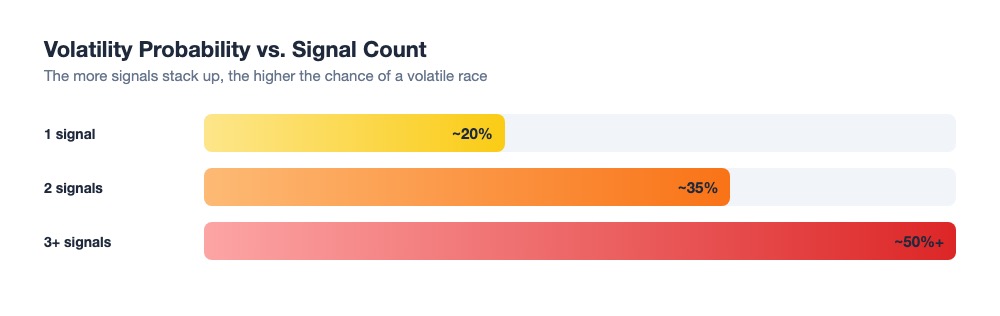
What matters most is whether multiple signals show up at the same time.
Approximate probability of a volatile race
- 1 signal: ~20% chance of volatility
- 2 signals: ~35% chance of volatility
- 3+ signals: ~50%+ chance of volatility ⚠️⚠️
For example, a situation like this:
- Lane 1's win rate is 5.2 (Signal 1)
- Lane 1's motor 2nd-place rate is 25%, lane 5's is 45% (Signal 2)
- A headwind of 6m (Signal 3)
→ 3 signals stack up, and the race is very likely to be volatile
In a situation like this, using Ryujin Radar's Upset Index to guide a longshot bet for a bigger payout is an effective approach.
Put Ryujin Radar's "Upset Index" to use
Ryujin Radar analyzes these signals together and displays an "Upset Index" for every race.
How to read the Upset Index
- 😌 Favorite friendly: lane 1 is favored, best suited for a favorite-focused bet
- 😐 Standard: a balanced race
- 😬 Upset alert (high): an upset is likely, worth considering a bet aimed at a bigger payout
Using this Upset Index to adjust how you bet lets you optimize both hit rate and return rate.
A real example: Heiwajima Race 10, December 15, 2025
Let's verify this with an actual race.
Race conditions
- Lane 1: win rate 5.3, motor 2nd-place rate 26%, average ST 0.18
- Lane 5: win rate 6.5, motor 2nd-place rate 48%, average ST 0.14
- Weather: headwind 7m
Checking the signals
✅ Signal 1: lane 1 win rate 5.3 (under 5.5) ✅ Signal 2: motor gap of 22 points (20+) ✅ Signal 3: headwind 7m (5m+) ✅ Signal 5: average ST 0.18 (0.17+)
→ 4 signals stack up, and the chance of a volatile race is very high
The result
- 1st: lane 5
- 2nd: lane 4
- 3rd: lane 2
- Trifecta: 5-4-2 → payout of ¥28,340
Ryujin Radar's Upset Index showed "Upset alert (high)," and lane 5 did indeed take 1st place, hitting exactly.
Summary: spot a volatile race and adjust your strategy
Here are the 5 signals that predict a volatile race.
- Lane 1's national win rate is under 5.5
- The motor 2nd-place rate gap is 20 points or more
- A headwind of 5m or more
- Lane 1 looks close to a flying start in the exhibition
- Lane 1's average ST is 0.17 or worse
Be extra cautious when 2 or more of these signals show up. Switch away from a favorite-focused bet and toward a longshot strategy targeting a bigger payout.
How to use Ryujin Radar
- Check the "Upset Index" for each race
- If the Upset Index shows "😬 Upset alert (high)" → consider a bet aimed at a bigger payout
- Cross-check the signals yourself to raise your confidence further
Spotting a volatile race in advance is a key skill for winning consistently at boat racing. Put data-driven predictions into practice with Ryujin Radar!
Check the Upset Index on Ryujin Radar now → https://boat-ai.jp/