Do you think "Trifecta bets just never hit"?
It's true that with 120 possible combinations, betting randomly on a Trifecta almost never works out. But once you properly understand how to pick your anchor, how to narrow your combinations, and how to allocate your bankroll, Trifecta becomes the most efficient bet type for turning a profit.
This article breaks down a practical approach to raising your return rate on boat racing Trifecta bets.
What is a Trifecta? — Understanding how the payout works
The basics
A Trifecta requires picking the 1st, 2nd, and 3rd place finishers in exact order.
| Bet type | Combinations | Average payout |
|---|---|---|
| Trio | 20 | ~¥2,000 |
| Trifecta | 120 | ~¥7,000 |
| Exacta | 30 | ~¥2,000 |
With 6 times as many combinations as a Trio bet, the biggest advantage is that payouts also tend to run higher.
Why is a Trifecta a good bet?
- A large payout when it hits means you can stay net-positive with relatively few wins
- Since you're predicting the exact finishing order, your own analytical skill is reflected directly in the result
- Betting is often heavily skewed toward the favorites, meaning some races have longshot combinations with strong expected value
Narrowing your bets — picking your anchor is 90% of the job
Step 1: Decide your 1st-place anchor
The single most important decision in a Trifecta bet is who to anchor for 1st place. Fixing 1st place alone cuts your combinations from 120 down to 20.
How to choose your 1st-place anchor:
- A Class A1 racer in the inside lane
- A racer with a motor 2nd-place-or-better rate of 40%+
- A boat that's out front in the start exhibition
- A racer Ryujin Radar's prediction shows high confidence in for 1st
Step 2: Narrow your 2nd-place candidates to 3–4 boats
Once you've anchored 1st place, narrow your 2nd-place candidates. Narrowing from the remaining 5 boats down to 3–4 is ideal.
Step 3: Decide your 3rd-place candidates
Choose your 3rd-place candidates, including boats you didn't pick for 2nd.
Formation vs. box — which is better?
Formation betting ✅
Specify your picks separately for 1st, 2nd, and 3rd. Its biggest strength is that it lets you narrow the combination count.
[Example] 1st: lane 1 / 2nd: 2, 3, 4 / 3rd: 2, 3, 4, 5
→ 1-2-3, 1-2-4, 1-2-5, 1-3-2, 1-3-4, 1-3-5,
  1-4-2, 1-4-3, 1-4-5 = 9 combinations
Box betting ⚠️
Bet every permutation of the boats you select. Combination count balloons quickly.
[Example] A 4-boat box with lanes 1, 2, 3, 4
→ 4×3×2 = 24 combinations
| Method | Pros | Cons |
|---|---|---|
| Formation | Lets you narrow your combinations | Requires predicting race development |
| Box | Requires less thinking | Combinations balloon, prone to breaking even or losing even on a hit |
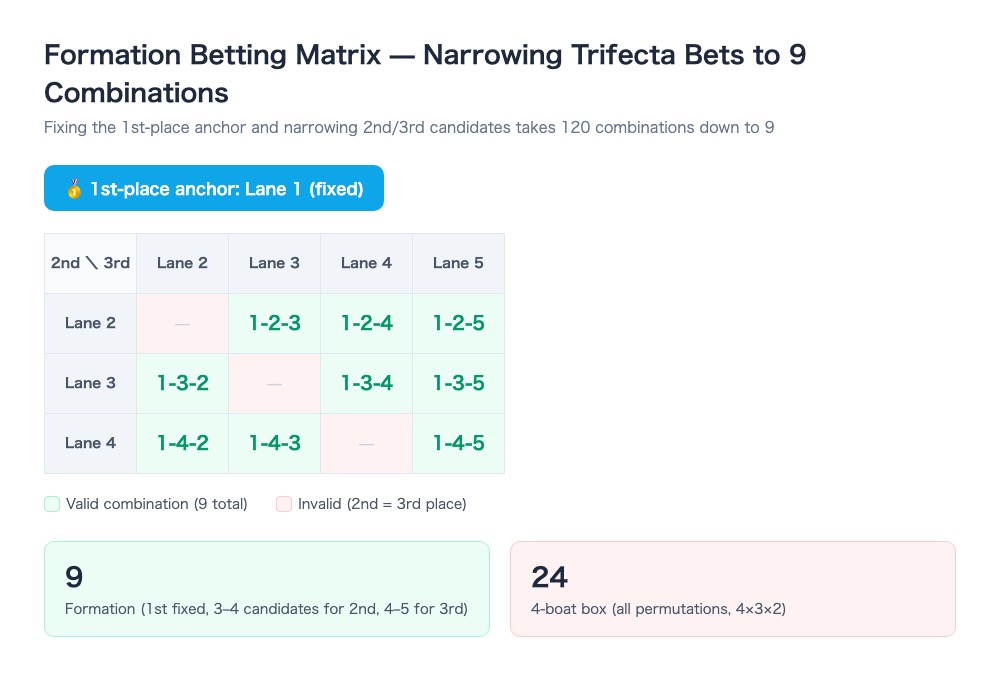
Bottom line: make Formation betting your default. Boxes tend to grow into too many combinations and eat away at the payout.
Return rate by combination count — how many should you bet?
The number of combinations you bet directly affects your return rate.
| Combinations | Approx. hit rate | Odds needed | Return-rate tendency |
|---|---|---|---|
| 6 | 15–20% | 30x+ | ⭐ Can target a high return rate |
| 12 | 25–35% | 35x+ | ✅ A balanced approach |
| 24 | 40–50% | 50x+ | ⚠️ Watch for break-even hits |
| 36+ | 50%+ | 70x+ | ❌ Almost always break-even or worse |
6–12 combinations is the sweet spot. Going beyond that makes it harder to actually profit even when you hit.
Lane 1 anchor vs. outside-lane anchor — choosing your strategy
Lane 1 anchor (targeting an inside wire-to-wire)
Lane 1's national average win rate is around 55% — the most stable anchor you can pick.
[The classic pattern]
1-2-3: the single most common outcome
1-2-4: a pattern involving a lane-4 inside pass
1-3-2: a pattern where lane 3 gets out ahead
Races this suits:
- Venues with a high inside win rate (Omura, Ashiya, Tokuyama)
- A Class A1 racer with a strong motor in lane 1
- Weak wind and calm water
Outside-lane anchor (targeting an overtake or inside pass)
Anchoring an outside lane lets you target a bigger payout.
[Outside-lane anchor patterns]
4-5-6: an outside overtake development
3-4-1: overtake + inside holds on
4-1-5: an inside-pass development
Races this suits:
- Lane 1's start looks slow (exhibition ST of 0.20 or worse)
- A Class A1 racer with a strong motor in an outside lane
- Venues where overtakes are common (Toda, Heiwajima, Edogawa)
How to think about bankroll allocation
Betting evenly costs you money
Betting the same amount on every combination is the least efficient approach.
Recommended: weighted allocation
Bet more on your top pick, less on your hedges.
[Example allocation for 12 combinations, ¥2,000 total]
Favorite (4 combos): ¥300 each = ¥1,200
Runner-up (4 combos): ¥100 each = ¥400
Hedge (4 combos): ¥100 each = ¥400
Rules of thumb for allocation
- Cap any single race at 5–10% of your bankroll
- Check that your favorite combination still profits at its odds if it hits
- Cut any combination that would break even or lose even on a hit
Building a Trifecta bet using Ryujin Radar's turn predictions
Ryujin Radar publishes free AI predictions built from integrated racer, motor, exhibition, and lane-specific data. Here's how to use them to build a Trifecta bet.
Steps
-
Check Ryujin Radar's prediction for the race
- Pick races where the 1st-place prediction has high confidence
-
Check the First-Mark Turn Prediction
- If it predicts "wire-to-wire" → build a formation around the inside anchor
- If it predicts "overtake" → build a formation around an outside anchor
-
Adjust your approach based on the Upset Index
- "Favorite friendly" label → a tighter, favorite-leaning bet of 6–8 combinations
- "Upset alert (high)" label → spread wider with 12 combinations, or switch to an outside anchor
-
Use the detailed turn data to narrow 2nd- and 3rd-place candidates
- Racers with strong attacking numbers → good 2nd-place candidates
- Racers with strong defensive numbers → good 3rd-place candidates
A worked example
[Ryujin Radar prediction]
1st: lane 1 (85% confidence)
Predicted development: wire-to-wire
Upset Index: Favorite friendly

[Bets]
1-2-3: ¥400 (favorite)
1-2-4: ¥300
1-3-2: ¥300
1-3-4: ¥200
1-4-2: ¥200
1-4-3: ¥100
= 6 combinations, ¥1,500 total
Summary — 5 rules for winning at Trifecta
- Narrow your 1st-place anchor to a single boat (an unfocused anchor makes your combination count explode)
- Use formation betting to keep it to 6–12 combinations
- Allocate your bankroll with weight, not evenly (flat betting is a mistake)
- Never forget to check for break-even combinations
- Use Ryujin Radar's turn predictions to streamline race selection and anchor picks
The Trifecta is a difficult bet, but narrowed correctly, it becomes the highest-return weapon in your arsenal. Start with Ryujin Radar's predictions as a reference, and try it with small amounts on races you feel confident about.
Check your predictions on Ryujin Radar now → https://boat-ai.jp/
FAQ
Formation or box — which actually makes more money?
It depends, but formation betting tends to have an edge: narrowing your combinations lets you put more money behind each pick with the same total budget, making a hit more likely to pay off. Box betting tends to rack up combinations, which makes it easier to end up "in the red on a hit" — winning but earning less than you spent.
If my 1st-place anchor misses, is the whole bet dead?
Yes. Both formation and box betting built around a fixed 1st-place anchor only pay out if that boat actually finishes 1st. If you're not confident in a single anchor for a given race, either spread the anchor across a couple of boats or pick a different race where your 1st-place read is stronger.
What does it mean to be "in the red on a hit"?
It's when your bet actually wins, but the payout ends up lower than what you spent (number of combinations × unit price). It tends to happen when you buy too many combinations. Keeping your bet to around 6–12 combinations, and weighting more money toward your top picks, is the basic way to avoid it.
How many combinations should a beginner start with?
Starting with a formation bet of around 6 combinations is a good approach. Fewer combinations means you can put more behind each one, which makes a hit feel more rewarding and makes it easier to learn bankroll management along the way.
Tags: #BoatRacing #Trifecta #HowToBet #BettingTickets #RyujinRadar